History of Eddy Current Testing
时间:2019-10-25 10:42 来源:未知 作者:admin 点击:次
The phenomenon of eddy currents was discovered by French physicist Léon Foucault in 1851, and for this reason eddy currents are sometimes called Foucault currents.
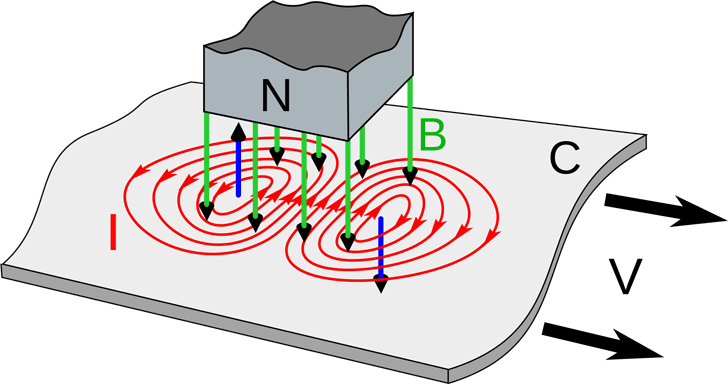 Eddy current testing began largely as a result of the English scientist Michael Faraday's discovery of electromagnetic induction in 1831. Faraday discovered that when a magnetic field passes through a conductor (a material in which electrons move easily)-or when a conductor passes through a magnetic field-an electric current will flow through the conductor if there is a closed path through which the current can circulate. In 1879, another breakthrough was made when another English scientist, David Hughes, demonstrated how the properties of a coil change when placed in contact with metals of different conductivity and permeability. However, it was not until the Second World War that these developments in the transmitting and receiving of electromagnetic waves were put to practical use for materials testing. Beginning in 1933, in Germany, while working for the Kaiser-Wilhelm-Institute, Professor Friedrich Förster adapted eddy current technology to industrial use, developing instruments for measuring conductivity and for sorting mixed-up ferrous components. In 1948, Förster founded his own company in Reutlingen, a business based on eddy current testing that continues to this day. Other companies soon followed. Many advances were made throughout the 1950s and 1960s, especially in the aircraft and nuclear industries. There have been many recent developments in eddy current testing, leading to improved performance and the development of new applications. Eddy current testing is now a widely used and well-understood inspection technique for flaw detection as well as for thickness and conductivity measurements. Benefits of Eddy Current Testing Eddy current offers the following capabilities: Benefits of Eddy Current Array Testing Compared to single-channel eddy current technology, eddy current array technology provides the following benefits: Drastically reduces inspection time. Covers a large area in one single pass. Reduces the complexity of mechanical and robotic scanning systems. Provides real-time cartography of the inspected region, facilitating data interpretation. Is well suited for complex part geometries. Improves reliability and probability of detection (POD). (责任编辑:admin) |