Application of Nondestructive Testing Technology in Wood Ind
时间:2019-11-19 15:21 来源:未知 作者:admin 点击:次
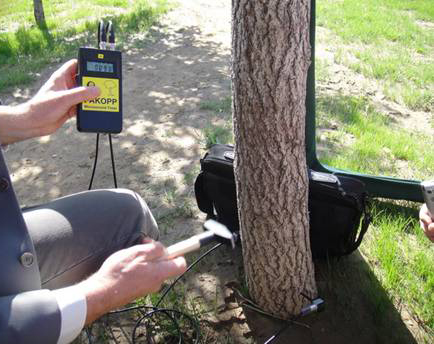 Non-destructive testing is the use of different physical and mechanical properties of materials to destroy the characteristics of the target object (such as shape, displacement, stress, optical properties, fluid properties, mechanical properties, etc.) without destroying the internal and external structures and characteristics of the target object. Conduct tests and inspections, especially for the measurement of various defects. The biggest feature of non-destructive testing is that it does not damage the original characteristics of the material, and can obtain the desired result in a short time, so that the operator can quickly make judgments, which is conducive to continuous production and improve production efficiency, and is also conducive to making correct decision making. Wood is a naturally growing plant material that is significantly different from isotropic materials such as metals, glass, plastics, ceramics, etc., with shape irregularities, variability and anisotropy, and thus is non-destructive to wood and its products. Detection has its own uniqueness. Non-destructive testing research and development must take different approaches depending on the shape and shape of the substance and product. Non-destructive testing of wood can be divided into trees, laminated timber, wood components, wood composites, etc. according to the objects to be tested. Different detection objects, detection targets and detection techniques used are different. Trees |