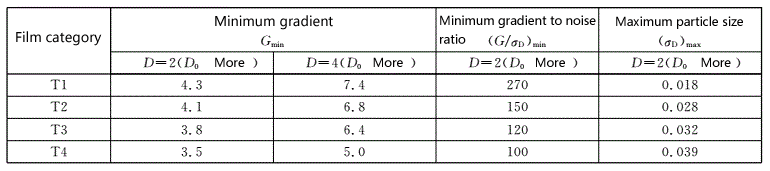
The quality of the film image in the radiographic inspection is closely related to the type of film. Different film quality requirements should use different films. Previously, the classification of film was based on the grain size, sensitivity, and contrast of the film. However, the quality of the film image is related to the processing of the film, in addition to the film itself. Therefore, international standards have changed the classification of film to the classification of film systems, which refers to the processing of film and film, which is more scientific and reasonable.
Gradient, gradient-to-noise ratio, and granularity limits
Sampling and storage
For product specifications, it is important that the results of the sample evaluation match the average results obtained by the user. In order to simulate the average shelf life of the product for normal use, the sample should be stored for a period of time as recommended by the manufacturer. The sample is selected and stored in this way in order to ensure that the characteristics of the sample reflect the characteristics obtained by the user during use.
experiment method
Preparation
The sample should be exposed by an X-ray machine of a tungsten target tube. The inherent filtration of the tube, plus the copper filter plate as close as possible to the target location, should provide a copper filtration equivalent equivalent to (8.00 ± 0.05) mm. The X-ray tube voltage was adjusted until a half-value absorption value of a copper plate thickness of (3.5 ± 0.2) mm was obtained. Usually a voltage of around 220KV can meet this requirement.
The film system shall include a lead intensifying screen of 0.02 mm to 0.04 mm before and after. If a single-sided coating winch is used, the emulsion layer shall face the X-ray tube and the film shall be in good contact with the intensifying screen.
2. Measurement of gradient G
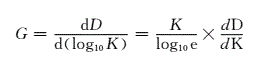
The gradient G is related to the D-log10K relationship curve. The gradient G is determined by two specific density points. They are at a density of 2 above the fog and base density and at a density of 4 above the fog and base density.
formula:
K---Density required for density (D-D0)
D0---Unexposed and processed film includes the optical density of the substrate.
The D-K curve approximates a cubic polynomial. To obtain a reliable curve, a series of exposures are made to provide at least 12 evenly distributed measurement points between densities 1 and 5 above D0.
At a 95% confidence level, the maximum uncertainty of the measured gradient should be 5%.
3. Measurement of particle size δD
The particle size is determined by linearly scanning a negative scattering optical negative film with a microdensitometer.
The double-sided emulsion layer should be recorded during the measurement. This means that the depth of focus of the microdensity meter must include two layers. After correction, the reflected optical density is converted to a scattering optical density. Standard deviation δD is a measure of granularity
.
The optical density of the film should be D = 2.00 ± 0.05 above the fog and base density.
The scanning length on the radiographic film is at least 100 mm. The measurement aperture of the microdensitometer is (100 ± 5) um.
To limit low frequency noise, the data measured by the microdensitometer is filtered using a high-pass filter with a spatial cutoff frequency of 0.1 line pairs per millimeter. (责任编辑:admin) |